Thursday, August 5, 2010

Fun Fact: Wrong Sense of Rotation for Deming's PDCA Wheel

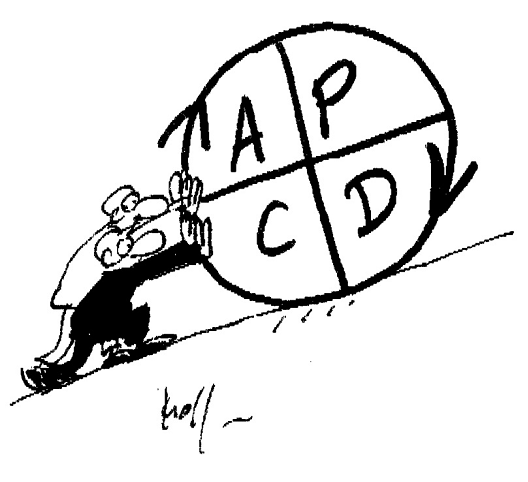
Have you noticed how many times management consultants draw the PDCA wheel so that the way to climb up the hill is ACDP and not PDCA?

ACDP wheel
This picture from [GE] Paeger Consulting.

Saturday, July 31, 2010

Enterprise-Size Authentication Is Not Just About Avoiding False Positives

When you're setting up an authentication method for access to an enterprise information system or to the enterprise premises, you don't want to just worry about false positives. You need to worry about the false negatives also.

Think about the logon screen of an application or website, asking for your username and password. The biggest worry of IT people behind that screen is to make sure the wrong people do not access the system. I think they should also care about the number of times the right people can't access the system either.

That's no big math, but suppose you would change a logon screen with 0.1% of false positives and 1% of false negatives (each losing the company 0.5$ because of the time lost for work) for a new logon screen with 0.01% of false positives and 3% of false negatives. Additionally, suppose the logon screen is used by 10,000 employees five times a day, 300 days a year.

The change would represent a loss of:
2% of additional false negatives
x 0.5$ each time
x 10,000 employees
x 300 days a year
x 5 times a day
which equals 150,000 $ per year.

It makes sense to acquire the new logon screen (let alone its own cost) if dividing by ten the losses due to intrusions in this system saves you more than 150,000 $ each year, that is, if the losses due to intrusions are above 170 000 $ per year, roughly.
Friday, July 30, 2010

Monthly ITsec Leadership Quotes and Articles: July 2010 (and June too)

Positive Leadership: Invest in People Building a Culture of Innovation.

Leadership Essay by former student Vince Fitzpatrick on the SANS Technology Institute's "Leadership Laboratory". The author comes back on the leadership he used when he was first appointed as CISO. It really reminds me of my own beginning.

Executives are Not Stupid on RiskAnalys.is, helpful to debug IT workers and ITsec workers when they think that everything is the management's fault.

Five reasons projects fail on Michael Krigsman's IT Project Failures.

'Wicked problems': collaboration, risk, and failure also on Michael Krigsman's IT Project Failures.

CISO and CSO Reporting Structures on the Security Recruiter Blog, on the shift of ITsec from defence to legal compliance.

Why "Doing ITIL" Doesn't Work (And How to Fix It): a direct, simple, summary of why ITIL is no silver bullet. Keep in bookmarks in order to cool down a manager, some day.

Can You Compete With the Next Generation of Security Leadership? (Yes, we can.)

Wednesday, June 23, 2010

Leadership learning 1

Wisdom being to recognize wisdom when you hear or see it, let me put it down what I heard from a management old-timer :
  • When somebody asks you about the goals of a project, answer goals.
  • When somebody asks you about the ethics of a project, answer ethics.
  • When somebody asks you about the management of a project, answer management.
  • When somebody asks you about the deadlines of a project, answer deadlines.
  • When somebody asks you about the means or technology of a project, answer means or technology.

Thursday, May 27, 2010

Notes: Profile for a CISO?

I was at the 4th International Forum on Cybercriminality and there was a conference about CISOs' professional profile.

I just took a few notes and, seemingly, there are three major kinds of personalities for a CISO:
  • The pilot,
  • The architect, IT urbanist,
  • The administrator.
I have no particular comment on this, except that I think I am doing my best to be all three of these :-\

I was also interested in this definition they gave: "The CISO is the one who defends the ITsec budget."

Finally, they described an evolution in the profile of CISOs:
  1. In the 1990's, people became CISO by opportunism,
  2. In the 2000's, people became CISO through competition,
  3. In the 2010's, people are becoming CISO by choice or by vocation.
I'm happy to record that I'm in the 2010's :-)

Wednesday, May 26, 2010

Monthly ITsec Leadership Quotes and Articles


I'm getting more and more convinced that the leadership style of Bruce Schneier is what made him so popular. There is more of personality than leadership in his case. In fact, my way to answer about "the mixture of security and feelings" is very close to his. Two examples:

A few quotes heard at the 4th International Forum on Cybercriminality :
  • "Nowadays you learn more about someone from Facebook than from Edvige." (Edvige is a nominative information file used by the French police.)
  • "The problem is not adapting to the digital world, it's adapting to the border-less world."
  • "In healthcare, IT security is a deontological requirement."
  • "Estonia is ahead of us [ahead of France regarding ITsec]."

Oh, by the way, I finally got a hint on why do they all emphasize on "Information Security" rather than "IT Security": I think it's because they want people to understand that it's not an IT-only problematic.

Thursday, May 13, 2010

Transparency the Next Big Topic? I Don't Think So :-(

Here is a recent Bruce Schneier interview "If you don't understand the people you'll never understand security, says Schneier". I really appreciate Bruce Schneier for his stick_to_the_fact and be_smart_not_an_automate approaches.

However, when he says during that interview that the next big topic for security will be transparency, I think it's more of a wishful thinking. I can see three main reasons why the move to transparency will be very slow:
  1. Good transparency requires transparency from both the vendor and the buyer. I think the buyer will never see the point of publishing data about (in)security. Even if that's more or less a kind of corporate social responsibility...
  2. Some major players among vendors and some managers in whatever buyer's hierarchy do not want to play the game by the rules. They prefer it the way it is, especially if they have a good ROI/good wages and not too much stress. So, unless there is some interventionism, I think they will do their best to slow the move.
  3. If you're going to publish things transparently, you might think of it as a possible bad advertisement for your company. And the weak point is: most companies, buyers or vendors, do not know where they stand among peers on the criteria of IT security. So they will not want to make the first move and risk publishing what might be seen as bad results.
To my mind, the whole business of IT security transparency is, as most of corporate social responsibility issues, a wicked problem. For this reason, it will require some good leaders to design new models and, probably, some interventionism from States and big corporate players. That is: it will move slowly (decades, to my mind).